The 1985 Mustang GT Twister II: Kansas City’s 90-Car Fox Body Special
Walk the rows of Mustangs at the Carlisle Ford Nationals and you will pass plenty of white 5.0 Foxbody hatchbacks. Most people slow down for the loud ones, the Saleens, the cars with the open hoods. Most people don’t realize that one of the rarest Fox Bodies on the field in 2025 looked, from ten feet away, like a clean 1985 GT with some extra graphics.
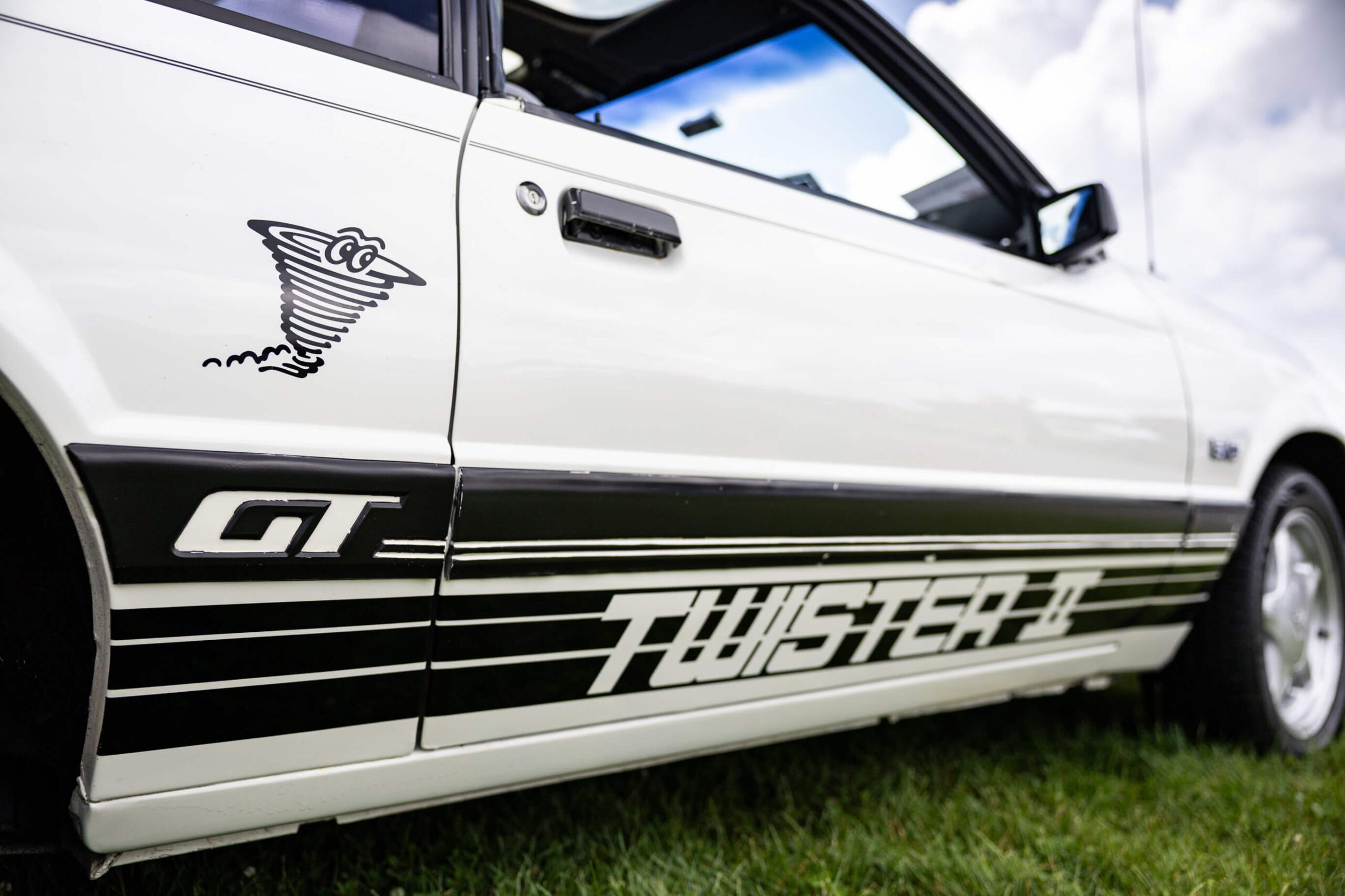
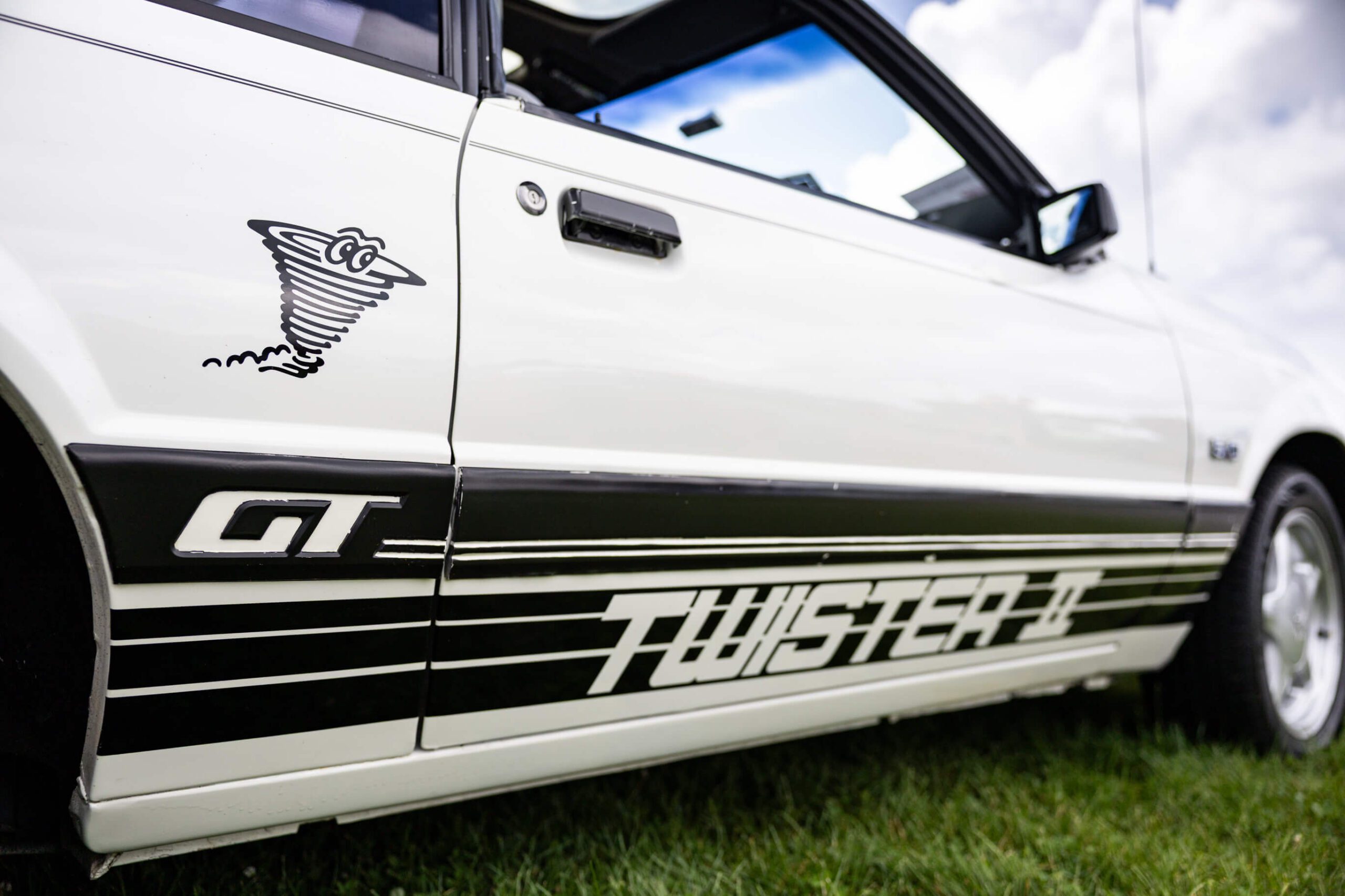
Get closer and the rocker stripes spell it out: TWISTER II. This is a 1985 Mustang GT Twister II, a Kansas City District special that only 90 buyers ever took home new. Here is the story behind it, what actually makes one, and how to tell a real Twister II from a GT wearing the decals.

The Original: The 1970 Mach 1 Twister Special
To understand the Twister II, start with the car it honored. The original Twister Special was a 1970 Mach 1 built only for dealers in Ford’s Kansas City District Sales Office (DSO 53). That district covered Kansas, Missouri, and the northwest corner of Arkansas.
The car happened almost by accident. Ford’s Special Promotions group had developed graphics for a small batch of Mustangs for American Raceways Inc. When that project fell apart, Ford handed the package to the Kansas City dealers as a regional promotion. Named for the tornadoes the Midwest knows too well, the cars got a funnel cloud decal on each rear quarter.
Here is what the original looked like on paper:
- 96 cars, all 1970 Mach 1 fastbacks, built at Dearborn in October 1969 and numbered consecutively
- Grabber Orange paint with black Twister Special graphics, a Shaker hood, power steering, and power front disc brakes
- 48 cars with the 428 Cobra Jet and 48 with the new 351 Cleveland four-barrel, a split that came down to how many 428s Ford had on hand
The Twister Specials debuted on November 7, 1969, at Ford’s Total Performance Day at Kansas City Raceway, lined up alongside a run of Torino Cobras. Today they are among the most collectible regional Mustangs ever sold.

Image sourced from: Ford Heritage Vault
Fifteen Years Later: The 1985 Twister II
By 1985, the 5.0 was getting its swagger back. The new GT made 210 horsepower, up 35 from 1984, and quickly became the decade’s performance bargain. That timing mattered.
With a push from longtime Mustang enthusiasts, Ford and the Kansas City District teamed up again to mark the original’s 15th anniversary. The result was the Twister II: 90 GT hatchbacks and convertibles, all scheduled for production in October 1984.
The launch even echoed the first one. The Twister II debuted in November 1984 at a luncheon at the Marriott in Overland Park, Kansas, parked alongside several 1970 Twister Specials. Same district, same tornado, fifteen years apart.

What Makes a Twister II (and What Doesn’t)
Let’s clear this up first, because it is the most common misconception: the Twister II is not a faster 1985 GT. It received no performance upgrades over a regular GT. It is a factory GT with a district-applied appearance package.
That still means you got everything that made the 1985 GT great:
- 5-speed cars: 5.0L HO with a four-barrel carburetor, rated at 210 hp and 265 lb-ft
- Automatic cars: 5.0L with central fuel injection (CFI) and the AOD automatic, rated at 180 hp
- Chassis: Traction-Lok rear, the special handling package, quadra-shock rear suspension, and dual exhaust
- Options: anything a regular GT buyer could order, including T-tops, sunroof, air conditioning, power windows and locks, and rear defrost
What made it a Twister II was the package Kansas City added:
- Rocker stripes with cut-out “TWISTER II” lettering, running below the rub strip on both sides
- A black “tornado with eyes” decal ahead of each rear wheel, a direct nod to the 1970 car
- Black hood striping with the GT logo
- A bronze dash plate for the passenger side reading “1985 Limited Edition TWISTER II, Kansas City District, October 1984”
- An alabaster coaster and a press package meant for the buyer, including a photo of the Twister II with an original 1970 Twister Special
Here is the detail that trips up a lot of people. None of the decals went on at the factory. They were applied at the transport lot of Ford’s Claycomo plant near Kansas City, and nothing on the window sticker identified the car as a Twister II.
The dash plates and coasters also shipped separately to dealers. Many reportedly ended up as salespeople’s keepsakes instead of in the cars. So a Twister II missing its plate is not unusual, and a car with a plate still needs paperwork to back it up.

1985 Twister II Production Numbers
Only 90 Twister IIs were built, and 83 of them were 5-speed cars. The breakdown by body style and transmission:
| Body style | 5-speed (4V carb, 210 hp) | Automatic (AOD, CFI, 180 hp) | Total |
| Hatchback | 74 | 2 | 76 |
| Convertible | 9 | 5 | 14 |
| Total | 83 | 7 | 90 |
Those two automatic hatchbacks are the true unicorns of the run. Nearly a dozen of the hatchbacks also got the optional 3.08 rear gears; none of the convertibles did.
Twister II Colors
Kansas City kept the palette tight. Only four colors were used:
- Bright Red (Jalapena Red), code 2R: the vast majority of cars
- Oxford White, code 9L
- Medium Canyon Red Metallic, code 2A
- Silver Metallic, code 1E
Enthusiast registry figures put the red cars at roughly 74. The owner of the car we photographed lists 14 in Oxford White on his display. If both numbers hold, that leaves only a couple of cars split between Canyon Red and Silver.

How to Identify a Real 1985 Twister II
Because the stripes went on after the car left the assembly line, decals prove nothing. A reproduction stripe kit can make any 1985 GT look the part. What you are really verifying is a GT with the right paperwork, and that comes down to a few checkpoints:
- DSO code 53. Check the middle to lower right of the driver’s door tag. It should read 53 for the Kansas City District. The same code appears on the original window sticker, warranty card, or build sheet.
- Scheduled build date of 10/84. Look at the upper left of the door tag. The actual build date on a warranty card may show late September 1984.
- VIN range. The last six digits should fall within 109800 to 109899, 110300 to 110399, or 112200 to 112299. Regular GTs also fall in these ranges, so a matching VIN supports the case but does not settle it. Make sure the VIN matches the dash, door tag, and buck tag.
- Paint code. It must be 2R, 9L, 2A, or 1E. A Twister II in any other factory color is not a Twister II.
- Body and drivetrain. It should be a 5.0 GT hatchback or GT convertible.
The gold standard is a Marti Report. Built from Ford’s licensed production records, it confirms how the car left the factory, including its DSO, build date, paint, and options. One thing worth knowing: a Marti Report documents production. It cannot tell you how many examples survive today.

The Twister II We Found at Carlisle 2025
The car we spotted at the 2025 Carlisle Ford Nationals belongs to Robert Bartolomei Jr. of Old Forge, Pennsylvania. It is an Oxford White GT hatchback with T-tops, a 5-speed, and a grey interior. A car built for Kansas City dealers in 1984 now lives in northeast Pennsylvania as a family car: it has been in the Bartolomei family since 2008 and is a father and son project.
The owner’s display lays out the car’s credentials:
- Documented with a Marti Report
- 1 of 90 Twister IIs produced
- 1 of 24 T-top Twister IIs
- 1 of 14 in 9L Oxford White
The display also states this is one of two T-top Oxford White Twister IIs remaining. Survival counts are tough to confirm on any limited run, so treat that one as the owner’s own figure. Either way, a documented, T-top, 5-speed white Twister II is rare at any show.
Sharp-eyed Fox fans will notice the wheels. The car currently wears later-model pony-style wheels, not the wheels a 1985 GT left the factory with. We don’t know the story behind the swap, and that is part of the fun of how these cars live on.
In person, what stood out was how easy it would be to walk right past it. No wild build, nothing shouting for attention. Just the stripes, the tornado, and a placard that tells you exactly why you should stop.

Why the Twister II Matters
The Twister II will never be a horsepower story, and it doesn’t need to be. Its value is the story and the paperwork. It is one of the few Fox Body specials that ties directly back to a 1970 Mach 1, and enthusiasts asked for it.
Regional dealer specials are Mustang history told at the local level. They show how district offices and dealers used the Mustang name to bring people into showrooms, and how those cars became time capsules of a specific place and moment.
That is also why values can be a debate. Some collectors see a cosmetic package on a regular GT. Others see a documented, 90-car piece of Mustang lineage. Both views have a point, and documentation separates the two conversations.
Now we want to hear from you. Have you ever seen a Twister II in person, red or otherwise? And should a dealer-district special carry a premium over a standard GT? Tell us in the comments.

1985 Mustang Twister II FAQ
How many 1985 Mustang Twister IIs were made? Ninety: 76 hatchbacks and 14 convertibles, all scheduled for October 1984 production.
Was the Twister II faster than a regular 1985 GT? No. It had the same drivetrain as any 1985 GT. The package was appearance only, plus the dash plate, coaster, and press kit.
Where was the Twister II sold? Ford sold it through its Kansas City District Sales Office (DSO 53), which covered dealers across large parts of Kansas and Missouri.
What colors did the Twister II come in? Bright Red (Jalapena Red), Oxford White, Medium Canyon Red Metallic, and Silver Metallic. Most were red.
How do I know if a Twister II is real? Check for DSO 53 and a 10/84 build date on the door tag, a VIN in the known ranges, and one of the four correct paint codes. A Marti Report is the strongest documentation.
What was the original Twister Special? A 1970 Mach 1 built for the same Kansas City District. Ford made 96, all in Grabber Orange, split evenly between the 428 Cobra Jet and the 351 Cleveland.