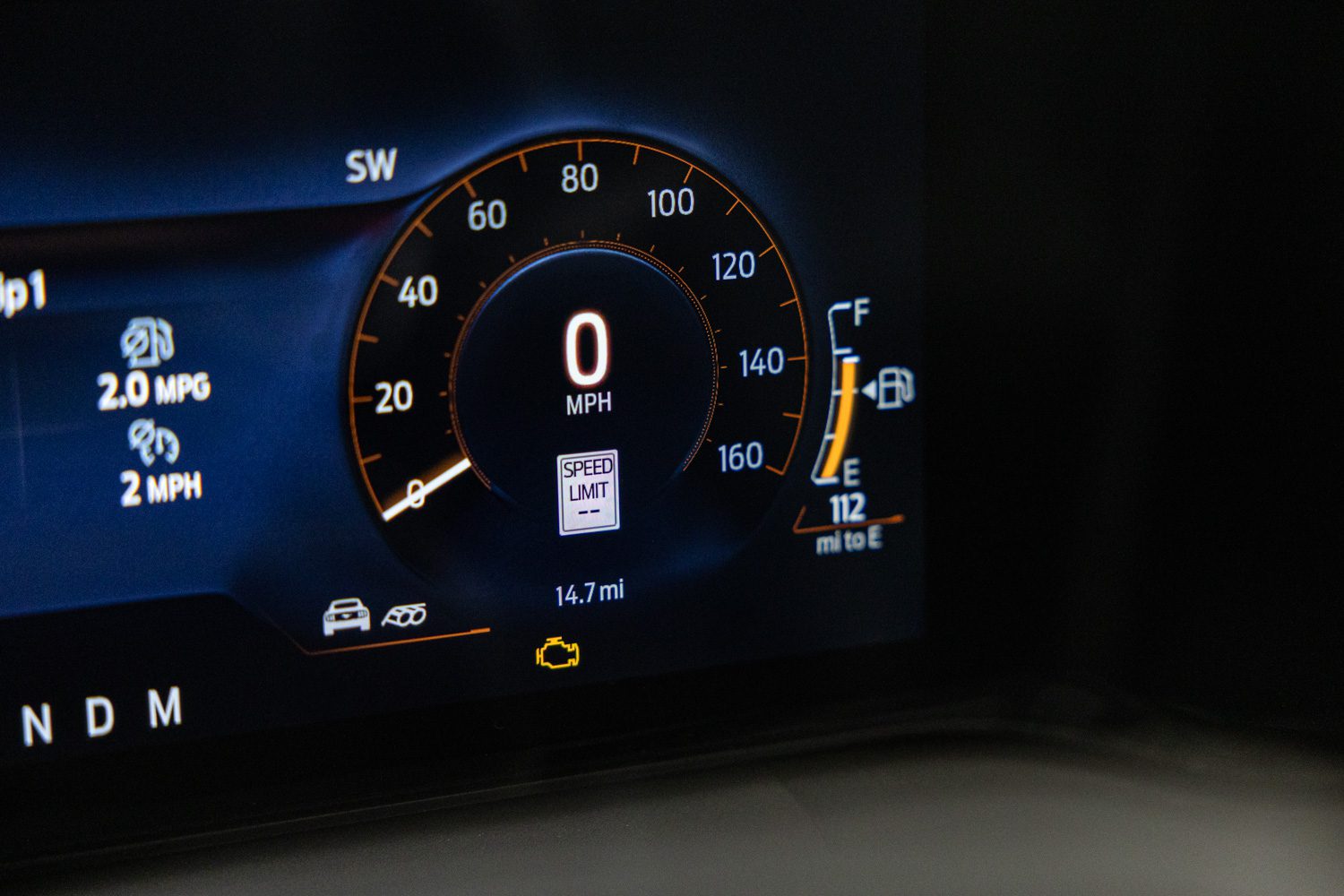
Mustang Check Engine Light Codes: The Complete Owner’s Guide
Your Mustang’s check engine light came on. Somewhere on the internet, a forum post is telling you it’s the catalytic converter. Another one says it’s the gas cap. A parts store printed a code on a slip of paper and handed you a box off the shelf.
None of that is diagnosis. It’s guessing with extra steps.
This guide is the foundation of everything Mustang Fan Club publishes on diagnostic trouble codes. It covers what the codes actually are, how the system that generates them works, what your scanner is and is not showing you, and how to move from “the light is on” to “I know what’s wrong” without throwing parts at the car.
It applies to every Mustang built since 1996, from a base V6 SN95 to a 2026 Dark Horse. The code system is the same across all of them. What changes is the interpretation, and that’s where the model-specific guides linked throughout come in.

MUSTANG CODE LOOKUP
Enter a check-engine code. Filter by your car for a tailored answer.
Part One: What the Light Actually Means
The check engine light, properly called the Malfunction Indicator Lamp or MIL, is not a general “something is wrong” warning. It’s an emissions warning. It illuminates when the Powertrain Control Module detects a fault that could cause the car to exceed its certified emissions standard, or when a component in the emissions monitoring system itself has failed.
That distinction matters more than most owners realize. A serious mechanical problem can exist with no light at all. A trivial problem can turn the light on immediately.
Solid versus flashing
Solid light: a fault has been detected and confirmed. The car is generally safe to drive to a shop or home. Drive gently, skip the on-ramp pulls, and get it diagnosed.
Flashing light: stop driving. A flashing MIL indicates a misfire severe enough to dump raw fuel into the exhaust, which will destroy a catalytic converter in a matter of minutes. On a Coyote, that’s a four-figure repair that started as a sixty-dollar coil pack. Pull over, shut it off, and have it towed or diagnosed on the spot.
The light going off does not mean the problem went away
Most emissions faults require two consecutive failed drive cycles to illuminate the MIL, and three consecutive passing cycles to extinguish it. If the light goes out on its own, the fault stopped recurring. The code is almost always still stored in memory, and the underlying condition may well come back.

This is one of the most useful things to understand about the system: the light is a lagging indicator. The data behind it is far more detailed than the light itself.
Part Two: The Anatomy of a Code
Every OBD-II diagnostic trouble code is five characters. It is not random. Each position tells you something specific, and once you can read the structure, you can extract meaning from a code you’ve never seen before.
Take P0316.
Character one: the system
| Letter | System | What it covers |
|---|---|---|
| P | Powertrain | Engine, transmission, fuel, ignition, emissions |
| B | Body | Interior systems, climate, restraints, lighting, comfort |
| C | Chassis | Brakes, ABS, steering, suspension, stability control |
| U | Network | Module-to-module communication faults |
The overwhelming majority of what owners deal with are P codes. B, C, and U codes exist on your Mustang right now in various modules, and most basic scanners cannot see them. More on that later.
Character two: who wrote the code
| Digit | Meaning |
|---|---|
| 0 | Generic, SAE standardized. Identical meaning on every manufacturer. |
| 1 | Manufacturer specific. On a Mustang, these are Ford’s codes. |
| 2 | Largely generic, a later expansion of the standardized set. |
| 3 | Largely manufacturer specific, with some standardized entries. |
This is the single most useful digit for troubleshooting your own research. A P0301 means “cylinder 1 misfire” on a Mustang, a Camry, and a Silverado. A P1450 means whatever Ford decided it means, and general OBD-II databases will often get it wrong or return nothing at all. When you’re looking up a P1 code, you need Ford-specific information or you’re reading fiction.
Character three: the subsystem
| Digit | Subsystem |
|---|---|
| 1 | Fuel and air metering |
| 2 | Fuel and air metering, injector circuit |
| 3 | Ignition system and misfire detection |
| 4 | Auxiliary emission controls (EVAP, catalyst, EGR, secondary air) |
| 5 | Vehicle speed, idle control, auxiliary inputs |
| 6 | Computer output circuits and module internal faults |
| 7 | Transmission |
| 8 | Transmission |
| 9 | Transmission, control module inputs and outputs |
| A, B, C | Hybrid and electrified propulsion |
So P316 is an ignition or misfire code before you look up anything. P420 is an auxiliary emission control code. P700-series is transmission. You can triage a printout in seconds with nothing but this table.
Characters four and five: the specific fault
The final two digits, 00 through 99, identify the exact condition. In misfire codes they frequently identify the cylinder: P0301 through P0308 map directly to cylinders 1 through 8. P0300 is random or multiple cylinder misfire, meaning the PCM detected misfires but could not isolate them to one cylinder.

Part Three: Which System Is Your Mustang Using
1996 to present: OBD-II
Every Mustang from the 1996 model year forward is OBD-II compliant. That was the federal mandate year, and it’s why 1996 is the hard dividing line in every conversation about Mustang diagnostics.
These cars have the standardized 16-pin J1962 diagnostic connector, located under the driver’s side dash, generally to the left of the steering column above the pedal box. Every scanner sold today plugs into it.
That’s a 30-year run of Mustangs on one diagnostic standard: SN95 and New Edge, S197, S550, and S650. A P0171 means “System Too Lean, Bank 1” on all of them.
Pre-1996: EEC-IV and OBD-I
Fox body and earlier Mustangs use Ford’s EEC-IV system with two- and three-digit codes, retrieved through a self-test connector on the driver-side firewall rather than a modern scan tool. Code 11 means system pass. Code 21 means engine coolant temperature sensor out of range. These codes have no relationship whatsoever to OBD-II codes, and plugging a modern reader into a Fox body accomplishes nothing.
We cover EEC-IV separately, because it deserves its own treatment and because mixing the two systems in one reference is how people end up chasing the wrong fault.
What changed under OBD-II that owners feel
The 1996 transition wasn’t just a new connector. It brought standardized code definitions, freeze frame data capture, readiness monitors, and the requirement that the PCM continuously self-test emissions systems during normal driving. Everything in the rest of this guide exists because of that mandate.
One more shift is on the horizon: the industry is beginning to transition to OBD-on-UDS, a newer diagnostic communication standard already appearing on some 2025 and 2026 model year vehicles. The codes themselves stay the same. The protocol underneath changes, and some older scan tools will eventually lose compatibility with the newest cars. Worth knowing if you’re buying a tool you expect to keep for a decade.
Part Four: The Four Kinds of Codes (And Why Your Scanner Only Shows One)
This is where most owner-level diagnosis falls apart. “The code” is not one thing. Your PCM stores diagnostic information in several distinct categories, and cheap scanners read exactly one of them.
Pending codes
A fault has been detected on one drive cycle but has not yet met the criteria to illuminate the MIL. No light, no confirmed code, but the PCM is watching. Pending codes are the earliest warning available to you, and they’re enormously useful for catching a developing problem, especially a marginal sensor or an intermittent misfire.
Confirmed or stored codes
The fault occurred on consecutive drive cycles and met the threshold. MIL is on. This is what a basic reader shows you.
Permanent codes
Introduced to close an obvious loophole. When a code is confirmed and the MIL illuminates, a permanent version is written to non-volatile memory. It cannot be cleared with a scan tool or by disconnecting the battery.
The only way it goes away is for the PCM to run the relevant monitor and confirm the fault is actually gone. Ford’s implementation clears the permanent code after the system verifies the repair across consecutive fault-free monitoring cycles.
This exists specifically to prevent someone from clearing codes in the parking lot of an inspection station. If you were planning that, it doesn’t work, and it hasn’t worked for well over a decade.
Continuous memory codes
Here’s the one almost nobody knows about, and it’s the most interesting.
Your Mustang’s modules log faults that never rise to the level of an emissions concern and therefore never turn on a light. Body module faults. Network communication hiccups. ABS events. Sensor readings that went briefly implausible. These sit in module memory indefinitely.
Owners running full module scans routinely find codes on cars that have never illuminated a warning light, and they’re particularly common on cars that see track use, autocross, or aggressive driving where sensors get pushed into unusual operating ranges. A basic reader will tell you the car is clean. A full scan tells a very different story.
We cover this in depth in the full module scanning guide, because it changes what you think you know about your car’s condition.
Part Five: Scanner Tiers and What Each One Can Actually See
Buying the wrong tool is the most common and most expensive mistake in owner-level diagnosis. Here is the honest hierarchy.
Tier 1: Basic code readers and budget Bluetooth dongles
Roughly $15 to $40. Reads generic emissions-related powertrain codes. That’s it.
What you get: the P0 code number and a generic definition. Sometimes readiness monitor status. Sometimes freeze frame, often not.
What you don’t get: Ford-specific P1 codes, any B, C, or U codes, any module other than the PCM, live data of any real depth, and often no permanent code access.
This tier answers “is my check engine light something or nothing?” It does not diagnose anything.
There is also a real risk factor here. Extremely cheap unbranded ELM327 clones are unreliable, and there are documented cases of low-quality adapters corrupting module communication. This is not a place to save fifteen dollars.
Tier 2: Enhanced consumer scan tools
Roughly $100 to $250. The meaningful step up, and the right tool for most Mustang owners.
What you gain: Ford-enhanced codes including the P1 range, ABS and airbag module access, permanent DTC reading, proper freeze frame, live data with graphing, and Mode $06 on-board monitor test results.
Mode $06 alone justifies the tier. It shows you the raw test values the PCM measured against its pass/fail thresholds, which means you can see a catalytic converter or an EVAP system that is degrading but has not yet failed the threshold and set a code. That is the difference between reacting to a failure and predicting one.
Tier 3: FORScan
Software is free for Windows. The paid mobile app and a proper adapter run roughly $60 to $130 total.
FORScan is Ford-specific diagnostic software, and it is the enthusiast standard for a reason. With a supported adapter, it reads and clears DTCs from every module on the vehicle, streams live parameters from any of them, runs service functions and output tests, and on many models performs module configuration.
The claim frequently made about it, that it accesses functions locked out even in dealership software, is accurate for certain configuration operations. Adapter recommendations from the FORScan team center on OBDLink EX for USB and OBDLink MX+ or vLinker for wireless, specifically because they handle Ford’s separate HS-CAN and MS-CAN networks correctly.
Two caveats worth knowing before you buy. First, adapter quality is not optional here, and the compatibility list exists for a reason. Second, support for the very newest model years typically lags, so verify current S650 coverage before purchasing rather than assuming.
FORScan also crosses into configuration territory, where it becomes possible to change how your car behaves. That is genuinely powerful and genuinely a way to create problems. Read before you write.
Tier 4: Ford FDRS and dealer-level equipment
Module reprogramming, calibration updates, and factory service procedures. Ford sells subscription access to independent shops and individuals, but between the subscription cost and the required J2534 interface, this is territory for people doing volume work or specific programming tasks.
For most owners, a dealer visit for a software update is cheaper than the cost of the tooling.

Part Six: Freeze Frame, the Most Ignored Data on Your Car
When the PCM sets a confirmed code, it simultaneously captures a snapshot of operating conditions at the exact moment the fault occurred. Engine speed. Calculated load. Coolant temperature. Intake air temperature. Vehicle speed. Short and long-term fuel trim. Fuel system status.
This is the single most valuable diagnostic data available to an owner, and almost everyone clears it without ever looking.
Consider a P0300 random misfire. A freeze frame that shows 850 RPM, low load, and cold coolant temperature tells you a completely different story than a freeze frame showing 5,800 RPM, wide open throttle, and fully warm. The first is an idle-quality or fuel-delivery problem. The second is an ignition system that can’t keep up under load, which on a modified Mustang usually means plug gap, coil, or fuel supply.
Same code. Entirely different diagnosis. The code alone would have told you nothing.
Read freeze frame before you clear anything. Once you clear it, it’s gone permanently.
Part Seven: Readiness Monitors and Why Your Car Failed Inspection With No Light On
Your PCM runs a set of self-tests, called readiness monitors, to verify emissions systems are working. Most modern vehicles support up to eleven of them.
Continuous monitors run constantly whenever the engine is on: misfire, fuel system, and comprehensive component monitoring.
Non-continuous monitors run only when specific conditions are met. The catalyst monitor needs sustained cruise at operating temperature. The EVAP monitor needs a particular fuel level range, a specific ambient temperature window, and in some cases an extended key-off soak period.
Each monitor reports one of three states: Ready, Not Ready, or Not Supported.
The problem this creates
Clearing codes resets every monitor to Not Ready. So does disconnecting the battery.
For 2001 and newer vehicles, which is every Mustang anyone is currently inspecting, emissions programs generally allow only one incomplete monitor. Show up with a freshly cleared PCM, and you fail the inspection without a single code present, because the station can see the monitors are all unset. That pattern is exactly what they’re watching for.
Restoring readiness takes a proper drive cycle. Ford publishes a specific procedure, and the EVAP monitor in particular can take days of normal mixed driving to complete because of its narrow enabling conditions. There is no shortcut, and there is no scan tool function that sets monitors.
Practical takeaway: if you have an inspection coming up, do not clear codes and do not disconnect the battery in the week beforehand. If you just did repairs, verify monitor status with a scan tool before you drive to the station.

Part Eight: The Six Mistakes That Cost Mustang Owners the Most Money
1. Replacing the part named in the code. A P0135 is an oxygen sensor heater circuit code. The fault could be the sensor, the circuit, the connector, the fuse, or the PCM driver. The code names a circuit, not a failed part. This mistake alone accounts for an enormous share of unnecessary parts spending.
2. Clearing the code before recording it. Write down every code, in the order they’re listed, and pull freeze frame first. Clearing destroys the evidence.
3. Disconnecting the battery to reset the light. This clears codes, wipes freeze frame, resets readiness monitors, dumps the PCM’s learned adaptive values, and leaves permanent codes in place anyway. It fixes nothing and makes the next diagnosis harder.
4. Ignoring what changed. Did the code appear after an oil change, a tune, a set of headers, a cold air intake, a battery replacement, or a car wash? That timeline is diagnostic data. On the Coyote specifically, a low or degraded oil level triggers cam timing codes with no other symptom, which is why the very first check on a P0011 or P0024 family code is the dipstick.
5. Never checking for TSBs and recalls. Ford issues Technical Service Bulletins for known patterns, and many of the codes owners chase have a documented cause and a published fix. Recall lookup by VIN is free at NHTSA.gov, and Ford’s owner portal lists open field service actions and Customer Satisfaction Programs. Check before you spend money. Some of these are covered repairs.
6. Trusting a generic code database on a Ford-specific code. P1 codes require Ford information. A generic lookup site will frequently give you a definition from another manufacturer’s use of the same number.
Part Nine: A Diagnostic Sequence That Works
- Record everything. All codes, in order. Note which are pending, confirmed, and permanent.
- Pull freeze frame on the confirmed codes.
- Document the symptoms separately from the codes. Does it stumble cold? Under load? Only after highway driving? Symptoms and codes are two independent data sets, and where they agree is where the answer lives.
- Check the free stuff. Oil level and condition. Fuel cap seated. Recent work. Recent modifications. Anything obviously disconnected in the engine bay.
- Check TSBs and recalls by VIN.
- Interpret the codes together, not individually. Multiple codes usually share a root cause. Lean codes on both banks point upstream toward a common source, not to two coincidentally failed sensors. A misfire code plus a catalyst efficiency code usually means the misfire came first and killed the converter.
- Test before you buy. Live data, Mode $06, a multimeter, a smoke machine. The code tells you where to look. The test tells you what’s wrong.
- Repair, clear, verify. Complete a drive cycle and confirm the code stays gone and the monitors set.
Part Ten: When to Stop and Hand It Over
Owner-level diagnosis has a real ceiling, and there’s no shame in it. Take the car to a qualified shop or dealer when:
- The MIL is flashing. Every time, without exception.
- You have network or U-codes, which usually indicate wiring or module faults requiring diagrams and proper equipment.
- You have internal module faults, the P06xx family in particular.
- The fault is intermittent, and you’ve replaced parts twice already. You are now paying to guess. A shop’s diagnostic fee, typically a few hundred dollars, is cheaper than a third wrong part.
- The car is under warranty or has an open field service action. Do not touch it. Let Ford fix it and keep the paper trail.
- You’re dealing with fuel system pressure, high voltage, or anything requiring the car in the air. Know your limits and your tooling.
Part Eleven: Where to Go From Here
The code system is universal. The interpretation is not. What a P0420 means on a stock 2019 GT with 40,000 miles and what it means on a 2021 GT with long tube headers and a tune are completely different conversations, and the second one isn’t a failure at all.
Our generation-specific guides pick up where this one ends:
- 2018 to 2023 Mustang code guide, covering the Gen 3 Coyote’s direct injection architecture, the 2.3 EcoBoost, and the Voodoo and Predator 5.2s
- 2024 and newer Mustang code guide, covering the Gen 4 Coyote and the S650’s expanded module architecture
- The 20 most common Mustang codes, with real diagnostic paths for each
- Full module scanning and hidden codes, the FORScan deep dive
- Codes after modifications, for anyone running headers, a tune, boost, or E85
- Pre-1996 EEC-IV codes, for Fox body and earlier
Frequently Asked Questions
Can I drive with the check engine light on? If it’s solid, generally yes, briefly and gently, until you can diagnose it. If it’s flashing, no. A flashing MIL means an active misfire that will destroy your catalytic converter.
Will a code clear itself? The light will extinguish after several consecutive fault-free drive cycles. The stored code typically remains in memory, and the permanent code remains until the PCM verifies the repair.
Why does the parts store code reader show something different than my scanner? Different tools access different data. A store reader typically pulls only generic confirmed powertrain codes. It cannot see pending codes, Ford-enhanced codes, or codes in any module other than the PCM.
Does a tune or modification cause codes? Frequently. Aftermarket exhaust affects catalyst monitors, intake changes affect mass airflow calculations, and forced induction changes what the PCM considers normal across the board. Some of these are genuine faults, some are monitors reporting correctly on hardware the calibration no longer matches. Distinguishing between the two is its own subject, and it’s the one we cover in the modifications guide.
Can I pass inspection with a permanent code? Handling of permanent codes varies by program and jurisdiction. The dependable answer is that the underlying fault has to actually be repaired and verified by the PCM, because there is no way to erase a permanent code with a tool.
How much should a professional diagnosis cost? Typically in the range of one to two hours of shop labor. What you’re buying is the technician’s time on equipment and service information you don’t have, and after two wrong parts, it’s the cheaper path.
This guide is a diagnostic reference, not a repair manual. Diagnostic trouble codes identify circuits and conditions, not failed parts. Always verify a fault through testing before replacing components, and consult a qualified technician for any repair beyond your tooling or experience.