The Ford Mustang FP800S Is Finally Here. Here’s What Three Years of Waiting Actually Got Us.
Three years ago, I stood on the show floor at SEMA and photographed a bronze Mustang GT with a supercharger poking through the hood, wondering if it would ever actually make it to a dealer lot. This week, it did. The Ford Mustang FP800S package is officially available to order, and after digging past the initial “800 horsepower” headlines, there is a lot more going on here than most of the release coverage is telling you.
If you only read the surface-level stuff, you know it makes big power and costs $18,500. Here is everything else you need to know before you start pricing one out.
When and Where This Actually Started
The FP800S wasn’t dreamed up this summer. Ford Performance first revealed it as a concept package at the 2023 SEMA Show in Las Vegas, on October 31, 2023, alongside a wave of other Ford Performance Parts concepts for Mustang, Bronco, Ranger, and F-150. At the time, it was built on a 2024 Mustang GT with a six-speed manual, and Ford said flat out that a version of it would land in the Ford Performance catalog sometime in 2024.
That did not happen on schedule. The FP800S went quiet for about two years, largely overshadowed by the launch of the Mustang GTD, which understandably soaked up most of Ford’s performance marketing attention. In December 2025, a variant called the FP800S Bronze Magneride Package quietly resurfaced in Ford’s Custom Garage configurator with no press release, just bronze wheels and a listing. That was the first real sign this thing was going to ship. By July 2026, nearly three years after that SEMA reveal, Ford finally made it official: the FP800S is a real, orderable, dealer-installed package for the S650 Mustang GT.

What the FP800S Actually Is (And Isn’t)
This is important because a lot of coverage is treating it like a trim level. It is not. The FP800S is not a standalone Mustang model you order from the factory with a VIN that says “FP800S.” It is a Ford Performance parts package, built to be installed onto a Mustang GT you already own or are buying, either by a Ford-certified dealer technician or an ASE Gold-certified independent mechanic.
That distinction matters for two reasons. First, it means you are not waiting on an allocation the way you might for a Dark Horse or GTD build slot. You buy or already own a Coyote-powered GT, and the package gets installed on top of it. Second, and this is the part a lot of outlets are glossing over, Ford is explicit that installing this package through a certified installer does not void your factory warranty. That is genuinely rare in the world of 800 horsepower builds, where bolting on a supercharger typically means your powertrain warranty becomes a memory.
The package covers any 2024, 2025, or 2026 Mustang GT with the 5.0-liter Coyote V8, in coupe or convertible, with either the manual or automatic transmission.
The Engineering, Not Just the Horsepower Number
Here is where most of the release-day articles stopped digging. The heart of the FP800S is a Gen 6 Whipple 3.0-liter twin-screw supercharger, a step up from the Gen 5 unit Ford used on earlier packages. Whipple’s Gen 6 design uses a patented dual air pass and dual water pass system, meaning charge air gets cooled twice on its way into the engine, paired with dual intercoolers and an oversized heat exchanger with a high-flow intercooler pump. Functionally, that setup is what lets Ford’s engineers push a genuinely aggressive tune without the heat soak that usually limits how hard you can lean on a blower like this.
The result is 800 horsepower on cars without the active exhaust option, and 810 horsepower with it, along with 615 lb-ft of torque, an increase of roughly 200 lb-ft over a stock GT. Ford requires 91 octane premium fuel minimum to hit those numbers.
Power alone would overwhelm the rest of the car, so the package is not just a supercharger in a box. Pulled straight from Ford’s own Performance Parts listings, here is everything actually included:

- Gen 6 3.0L Whipple Supercharger, rated at 810 hp and 615 lb-ft (10 hp less without the active exhaust)
- Air Oil Separator Kit
- Ford Performance Half Shaft Upgrade Kit
- Uniquely tuned, track-capable suspension (MagneRide-calibrated or passive, depending on version)
- Flow Formed R1 Wheel Kit, 19×10.5 front and 19×11 rear
- A matching black or bronze lug nut kit
- Unique FP800S interior badge
- Ford Performance rear badge
- FP800S-style bodyside graphics
- A custom grille with Ford Performance grille badge and color-matched intake snorkels
- Unique FP800S key chains
- An Air Design decklid panel
- 5.0L fender badges
- Rear wheel spats
Two details worth calling out on the mechanical side. First, the MagneRide version of the package includes Ford Performance’s ProCal 4 tool specifically to handle the MagneRide suspension calibration, which is not needed on the passive version. Second, Ford’s own instruction sheets list this as shipping in four to five separate boxes weighing well over 1,000 pounds combined, which gives you a sense of just how much hardware is actually landing on your dealer’s loading dock for an $18,500 line item.
On naming: Ford is not using “MagneRide vs. non-MagneRide” as the label on its own site. The two suspension tunes are officially called MagneRide and Passive, and that Passive label is simply Ford’s term for the version built for GTs without the adaptive MagneRide dampers. So the four SKUs actually break down as:
- M-MUSTANG-FPS1A: Black, MagneRide
- M-MUSTANG-FPS1P: Black, Passive
- M-MUSTANG-FPS2A: Bronze, MagneRide
- M-MUSTANG-FPS2P: Bronze, Passive
All four are priced identically at $18,500 and carry Ford’s CARB “Fifty State Street Legal” designation when installed correctly.
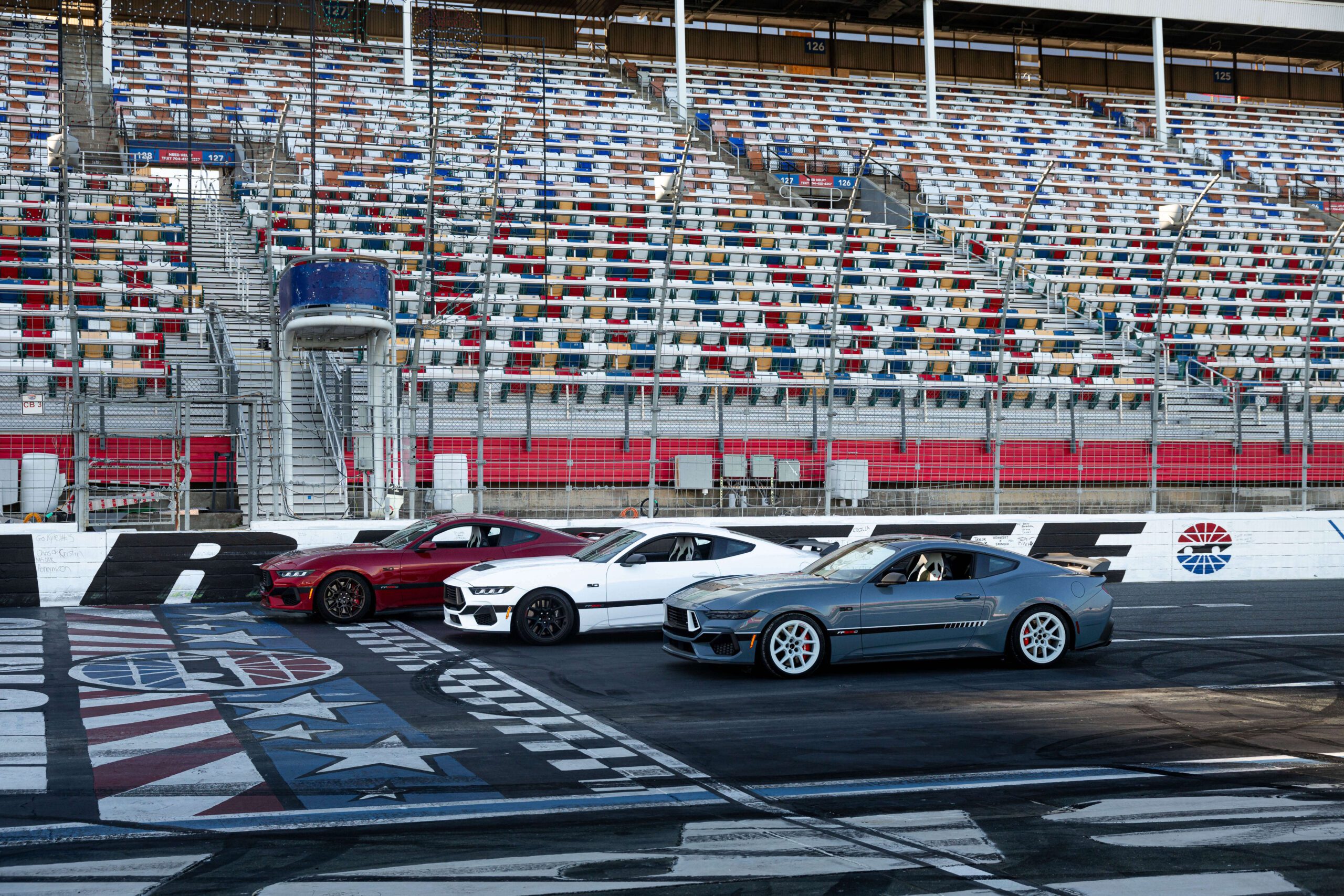
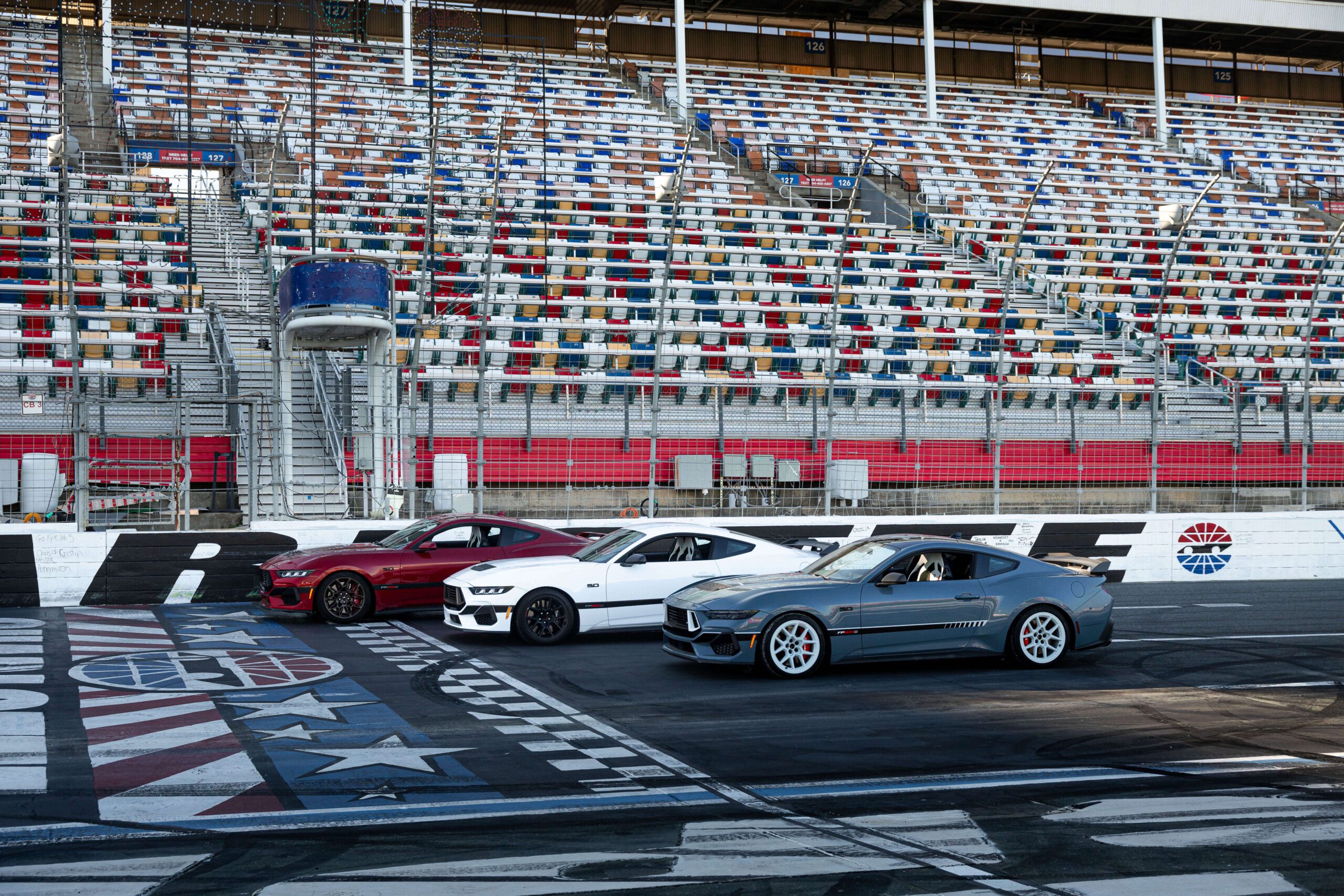
Worth noting for anyone cross-shopping colors: Ford’s current Performance Parts catalog only lists Black and Bronze as official SKUs, but a third wheel finish, Battleship Grey, has shown up on early press and influencer test cars and traces back to the original SEMA concept. It is the same Battleship Grey finish Ford already offers on Dark Horse wheel kits, so it would not be a surprise to see it added as a third FP800S option down the line. If you are set on that look specifically, confirm availability with your dealer before you order, since it is not one of the four SKUs currently live on Ford’s site.

The Suspension Deserves Its Own Headline
Most coverage treats the FP800S suspension as a footnote to the horsepower number, but it is arguably the more interesting engineering story. This is not a generic lowering kit borrowed from another trim.
The springs are tuned roughly 30 percent stiffer than what comes on the Dark Horse SC, Ford’s other high-output Mustang. That is a significant jump, and it signals Ford built this suspension specifically around the extra weight and grip demands of the supercharged package rather than reusing an off-the-shelf setup from elsewhere in the Mustang lineup.
The stabilizer bars are where it gets even more specific. The FP800S uses the largest stabilizer bar Ford could physically package under an S650 Mustang, front and rear. The front bar is adjustable across 4 positions and the rear bar across 3 notches, giving an installer or owner real range to dial in handling balance rather than being locked into one fixed setup.
Then there is the suspension choice itself. Buyers pick between MagneRide and Passive, and on MagneRide-equipped cars, Ford wrote a suspension calibration exclusive to the FP800S package, not a carryover from the standard GT or Dark Horse MagneRide tune. That calibration is baked into all three drive modes, Normal, Sport, and Track, so the adaptive dampers respond differently in this application than they would in any other Mustang on the lot. In short, this is not a bolt-on spring-and-shock kit wearing an FP800S badge. Ford engineered the whole chassis side of this package specifically around what an 810 hp Coyote demands.

Where This Sits in the Lineup
Here is our take at Mustang Fan Club on how the FP800S fits into Ford’s current performance hierarchy. We would position it just below the Dark Horse SC rather than alongside it. The Dark Horse SC comes from the factory as a complete, purpose-built package with its own aero, its own dual-clutch transmission, and a single window sticker. The FP800S gets you within 15 horsepower of that car, on a manual transmission the Dark Horse SC does not even offer, for tens of thousands less, but it asks you to assemble that value yourself across a vehicle purchase, a parts order, tires, and a separate labor invoice. That is a real advantage for the right buyer, and also a real gap for anyone expecting FP800S to be a one-and-done ordering experience the way Dark Horse SC is.

The CARB Angle Nobody Is Talking About
One detail buried in Ford’s own materials but skipped by most outlets: the FP800S is CARB compliant when installed by a dealer or ASE-certified technician. That means it is legal to run in California and other CARB-adopting states without the emissions gray area that comes with most aftermarket supercharger kits. If you have ever shopped for a blower for a car registered in California, you know how much that one line item actually matters.

The Number Nobody’s Advertising: What This Actually Costs
Every headline is leading with $18,500. That is accurate, but it is only the price of the parts. Nobody is walking through the full math, so let’s do that.
Start with a Mustang GT. Base MSRP runs roughly $48,000 to $49,000 depending on trim and options, before tax, title, and destination.
Add the $18,500 FP800S package, and you are already at approximately $67,000 to $68,500, and that number still does not include installation.
Here is the part almost nobody is mentioning: the FP800S comes with new wheels, but not new tires. Ford’s own part listing spells this out in fine print: tires and installation are sold separately, and the recommended fitment is 305/30ZR19 up front and 315/30ZR19 out back. That is not a size your factory GT tires can be reused in, and it is not a cheap size to shop for either.
Pricing that fits that fitment, a budget-oriented ultra-high-performance summer tire in this size runs roughly $200 to $350 per tire, or somewhere around $900 to $1,200 for a full set of four. A more appropriate choice for an 810 hp car, something like a Michelin Pilot Sport 4S, prices closer to $430 to $465 per tire up front and $460 to $500 per tire out back, which puts a proper set of four in the $1,800 to $1,900 range before mounting, balancing, and disposal fees, typically another $100 to $150 for a set.
Add professional installation labor, since this is a supercharger, half-shaft, suspension, and wheel install best left to a certified tech, not a driveway job. Realistic labor estimates run in the $4,000 to $5,000 range depending on the shop and region.
Now stack all of it together: roughly $48,000 for the base GT, $18,500 for the FP800S parts, somewhere around $1,900 to $2,000 for a proper set of tires mounted and balanced, and $4,000 to $5,000 in labor. That is already $72,000 to $76,000 before a single dollar of sales tax touches the vehicle and parts total. Depending on your state’s tax rate and the trim of GT you start with, it is entirely reasonable to land at $78,000 to $82,000 out the door once everything is accounted for, tires included.
That reframes the whole value conversation. Ford’s own comparisons point to the Mustang Dark Horse SC at $103,490 with 795 hp, or the Chevrolet Corvette Stingray around $70,000 to $71,500 as the natural cross-shop. But once you factor in tires, labor, and tax, honestly, the FP800S GT isn’t really an $18,500 upgrade to a $48,000 car. It’s a $75,000 to $80,000-plus Mustang, full stop, that happens to arrive in three or four separate purchases instead of one window sticker. That doesn’t make it a bad deal. An 810 hp, factory-warrantied, CARB-legal Mustang for meaningfully less than a Dark Horse SC is still a strong proposition. But it deserves to be shopped and budgeted like the $80K car it actually is, not the $18.5K accessory it’s being marketed as.

The Takeaway
The FP800S is proof that the concept car you photograph at SEMA doesn’t always die on the show floor, sometimes it just takes three years, a name change, and a quiet configurator listing to get there. For enthusiasts who have been chasing supercharged Coyote power without sacrificing a warranty, this is one of the more legitimate factory-backed paths to 800-plus horsepower that Ford has ever offered. Just walk in with your eyes open about what the total build actually costs, tires and labor included, once the whole picture is on the table and not just the line item Ford put in the press release.